 ≡
≡
Introducing The Buyer Awareness Cycle
Share on 


Nov 8, 2023 by Sean Luce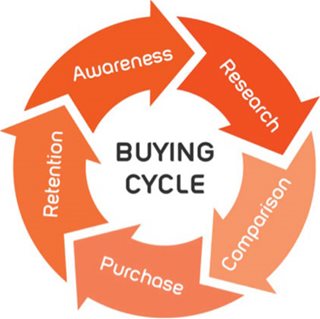 In my seminars, the most-requested research information that sales reps need to justify long-term schedules for their clients has been the "Buyer Awareness Cycle," or BAC. First, let me lay some pipe on why this research was initiated and how it has become a powerful tool for the industry.
The Radio Advertising Bureau has a "Business Survey" of 40 categories of retail business, and it shows the percentage of total annual sales by month for each category. This is a vital piece of research for Traditional & Digital sales reps, because it shows when purchases are actually made (by month). For example, the two biggest months for "Tire Dealers" are October and January, when 9.1 percent of business is done in each month. What this data does not show, however, is the point at which the customer starts his or her thought process in the purchase cycle - i.e., when the consumer starts thinking about a major tire purchase.
The "RAB Top 40" is a staple in my seminar handout materials. The survey takes into account something that is often forgotten when it comes to planning annual campaigns for clients, and that is how to figure the seasonality of their business. Selling a $60,000 campaign to run at $5,000 per month is a terrible disservice to the client, because the month-to-month business cycle can fluctuate drastically from the 12-month average. An effective campaign should flow according to the percentage of business that is done according to their market, and the RAB Top 40 is a valuable piece of research.
But there's an equally critical piece of information that sales reps can use to leverage prospects who say they just want to try the station( s) for a month and see if it works. That information is the Buyer Awareness Cycle.
The BAC 40
Methodology: Our research team at the LPG offices in Houston conducted this survey over the past three years. Typical consumers were interviewed by phone or in person for each specific product and service on the BAC list. At least 100 people were surveyed in each category. They were asked whether they had purchased any of the products or whether they had decided to buy that product or service. If they answered, "Yes," they were asked just how long they thought about that particular product. For example, for Floor Covering purchases over $500 (not including remnants), the BAC survey showed that the lead time - the time between the initial thought about floor covering until the consumer's step into the first floor-covering store - was an average of 6.2 months. This says that the consumer is in a thought process of 6.2 months, and that's the period when the consumer is most likely to be influenced by advertising, specifically through top-of-mind awareness, which is the strength of Broadcast and Digital.
Usage:You can match this information with the RAB Top 40's information on carpet stores, which says that the biggest month for purchases in the category is October. Now, use the BAC to back up six months to show the prospect that April is the time to ramp up for their biggest month, October if they indeed mirror the national average for purchases.
The BAC does not match exactly to the RAB Top 40 as there was no definitive BAC data for such categories as life insurance and movie theaters. However, many categories match the products. The BAC should be mandatory research taken by your sales reps to their clients and prospects.
Buyers Awareness Cycle Top 40
Product/Service | Time/Months |
All Terrain Vehicles (ATV’s) | 3.0 |
Appliances (Over $500) | 4.0 |
Auto New Domestic | 3.2 |
Auto New Foreign | 3.8 |
Auto Used Domestic | 2.6 |
Auto Used Foreign | 3.5 |
Bedding (New Mattresses) | 2.0 |
Bicycles | 4.4 |
Billiard Tables | 6.5 |
Boats (14’ +) | 8.5 |
Camera/Video Equipment (Major Purchases) | 2.6 |
Car Accessories (Over $300) | 4.6 |
Cell Phones/Service | 2.2 |
Computers | 2.1 |
Exercise Equipment (Over $500) | 9.6 |
Floor Covering (Not Remnants) | 6.2 |
Furniture (Over $500) | 3.9 |
Homes - Existing | 20.0 |
Homes - New | 21.0 |
Jewelry (Over $500) | 5.6 |
Joining Health Club | 4.4 |
Landscaping (Over $500) | 3.4 |
Luggage/Baggage (Over $350) | 6.7 |
Martial Arts/Yoga Classes | 3.6 |
Men’s Clothing & Accessories (Over $500) | 1.6 |
Motorcycles - Harley Davidson | 8.8 |
Motorcycles - Other than Harley Davidson | 6.4 |
Musical Instruments (Over $500) | 3.2 |
Pets (Cats/Dogs/Exotic) | 3.9 |
RV’s & Campers | 17.7 |
Snowmobiles | 3.9 |
Spa/Jacuzzis | 5.1 |
Stereo Equipment (Over $350) | 3.3 |
Swimming Pools | 9.6 |
Teeth Whitening | 4.6 |
Water Bikes (Wave Runners, Etc.) | 2.7 |
Waterbeds | 4.1 |
Women’s Clothing & Accessories (Over $350) | .8 |
BAC stands for Buyers Awareness Cycle or the pre-purchase experience. The definition of the BAC and PPE is the collection of brand touch-points and processes that significantly influence whether a prospect will place your brand into his or her final purchase consideration set on the way to making the actual purchase. This is the time that the consumer is thinking about making the purchase (thought mode), or when the switch goes off in the consumers head before they actually walk into the showroom or make the call for the service or product listed. The BAC does not take into consideration once they get in the store to actually purchase the product or sign up for the service. All figures are based on averages and will vary depending on seasonality of the business and location of store/business in North America. These are North American statistics only.
> Publications > Radio Ink

